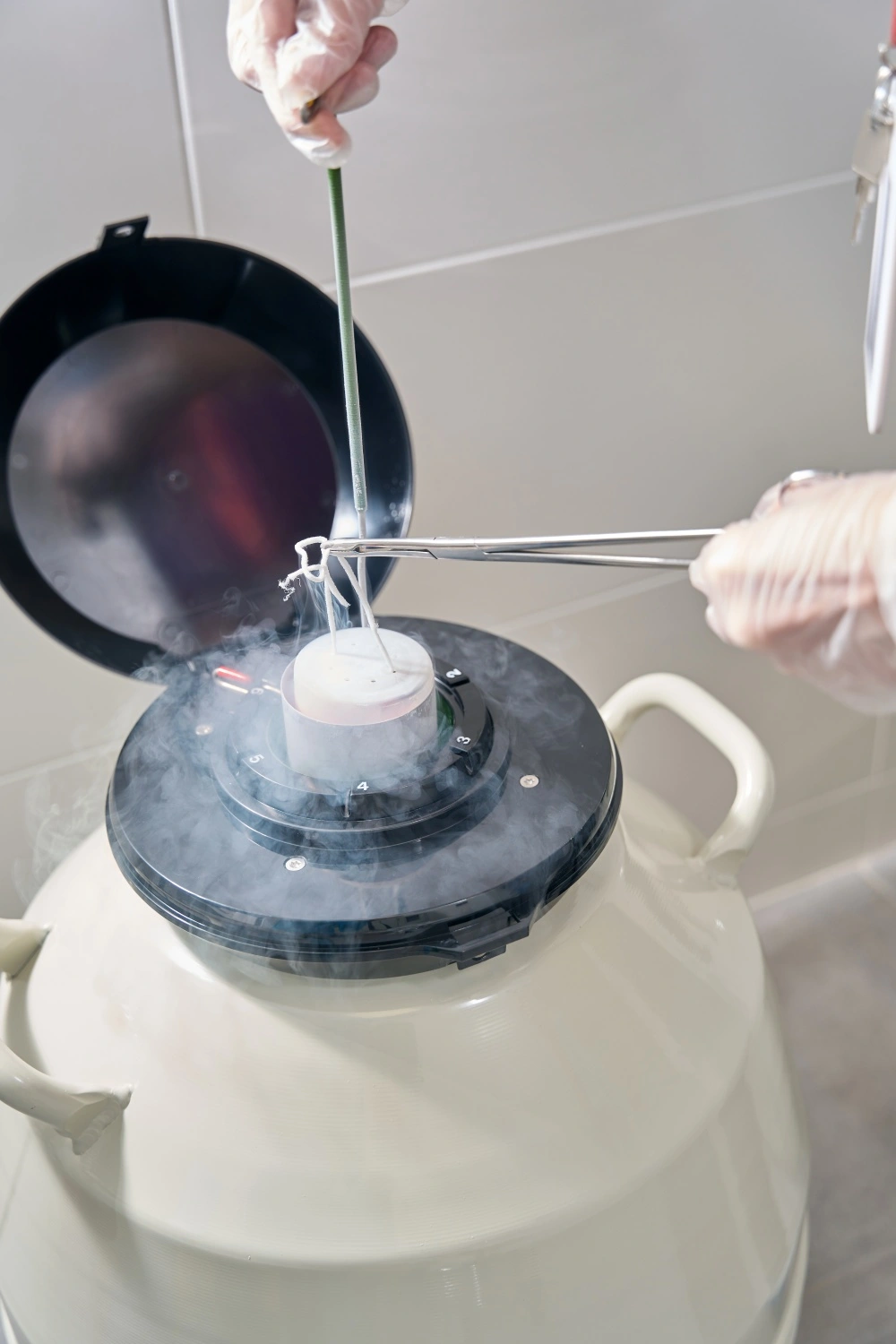
Planning for a family does not always mean being ready for pregnancy today. Egg freezing gives you the option to preserve eggs now for a future attempt at pregnancy. At Thrive IVF Fertility in Oklahoma City, we help you understand your options and create a plan around your health and family-building goals.
Egg freezing, also called oocyte cryopreservation, involves collecting mature eggs from the ovaries and freezing them without fertilizing them. This allows you to preserve eggs without choosing a sperm source or creating embryos at this stage.
The process begins with a consultation, bloodwork, and an ultrasound to assess your ovarian reserve and help plan treatment. You will use injectable medications to encourage several eggs to mature, with monitoring appointments to track your response. When the eggs are ready, they are collected during an outpatient retrieval procedure, and the mature eggs are frozen for future use.
Egg freezing may be an option if you want to delay pregnancy or need medical treatment that could affect fertility. Dr. Shaurin Patel can review your health history and goals and explain treatment, storage, and future IVF costs. Call 405-930-3483 or use our online contact form to get started.

Step
Step
Step
Step
Step
Step
Start Your Journey With Us Today!
Your next step can be a conversation about the future. Meet with Thrive IVF Fertility to explore egg freezing and understand what fertility preservation could look like for you.
Egg freezing generally offers better chances when eggs are frozen at a younger age, before the usual decline in egg quality. There is no single right age for everyone. Dr. Patel will discuss your age, ovarian reserve, health history, and plans to help you understand whether egg freezing makes sense for you.
Ovarian stimulation commonly involves about 10 to 12 days of injections, followed by egg retrieval and freezing. Your overall timeline also includes consultation, testing, and scheduling. Some patients complete more than one cycle, depending on their response and goals.
You may experience soreness from injections, bloating, or cramping. Egg retrieval is typically performed with sedation or anesthesia to help manage discomfort. Less common risks include bleeding, infection, and ovarian hyperstimulation syndrome (OHSS). Your care team will explain what to expect and how your response will be monitored.
The number depends on your age, ovarian reserve, response to medication, and family-building goals. Not every retrieved egg will be mature enough to freeze, and not every frozen egg will lead to a pregnancy. Dr. Patel will discuss a target and whether additional cycles may be helpful. Egg freezing does not guarantee a future baby.
When you are ready to use your eggs, they are thawed and fertilized with partner or donor sperm using IVF with ICSI, a technique that injects a single sperm into an egg. An embryo can then be transferred to the uterus to try to achieve pregnancy.